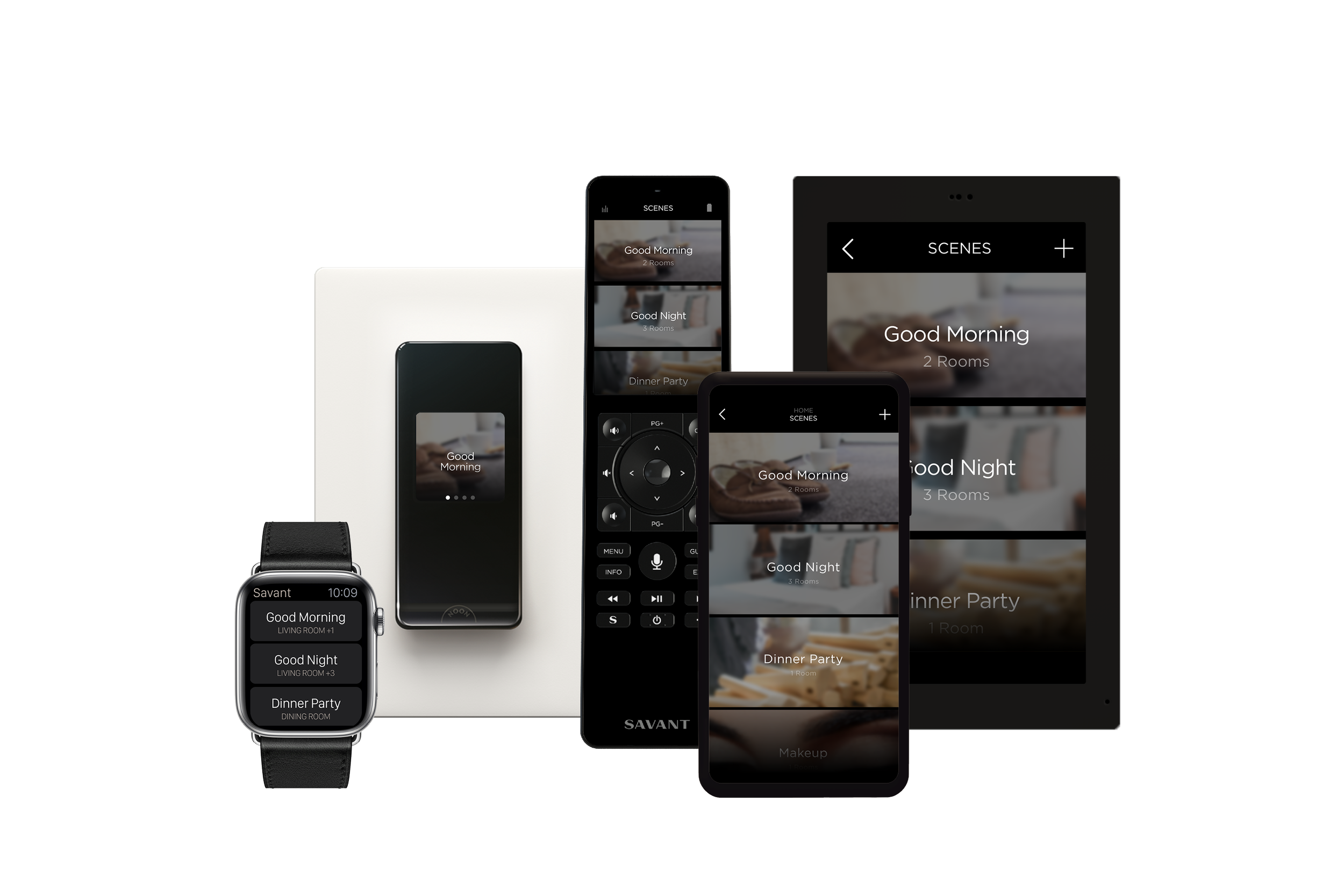
Savant Pro App
Nine years shaping the experience of a connected home.
I joined Savant in 2017 and grew from UX Designer to Lead Product Experience Designer. I have contributed to every Savant Pro app release from 5.6 through the current 12.1 beta, including the point releases between them. That means years of design, review, implementation, and refinement as the product and its capabilities have grown.
My work spans mobile, web, tvOS, connected controls, and residential power management. The central challenge has stayed consistent: make complex technical systems understandable and useful to the people living with them.
The people behind the system
For homeowners, the app turns a sophisticated installation into everyday actions: adjusting a room, finding music, running a scene, or understanding what the home is doing. The interface needs to make those actions clear without demanding knowledge of the systems behind them.
Professional integrators bring devices, services, and controls together around a particular home. Designing in this environment means understanding both the configured system and the person who will use it after installation.
A growing product ecosystem
During my time at Savant, the company expanded its lighting and energy ecosystem while continuing to serve the luxury, professionally installed smart-home market. In 2020, Racepoint Energy acquired NOON’s technology and team. Savant completed its acquisition of GE Lighting later that year.
The wider ecosystem now includes Cync, available through retailers including Lowe’s and Walmart. My Savant Pro work sits within that broader company story: more devices, more ways to enter the smart home, and a continuing need to make the experience feel coherent.
Designing across releases
I work across early concepts, user flows, high-fidelity interfaces, research, design reviews, engineering collaboration, and implementation review. Each new capability has to fit into an experience people already know, and shared patterns have to hold up across screens and connected hardware.
As my role grew, I also took on mentoring, maintaining shared design systems, and guiding UX quality across projects.
From complex data to useful decisions
Power management makes the challenge especially clear. Homeowners need to understand battery charge, energy consumption and production, system status, and which loads are running. During an outage, those signals inform decisions about what the home should prioritize.
My focus was turning complex energy data into something readable and useful, connecting a system-level dashboard with historical information and circuit-level controls.
Making automation understandable
Next Generation Scenes expanded scheduling into more flexible automation. I explored modular ways to represent triggers and actions, prototyped interactions, and worked with engineers on what the system could support—helping homeowners and installers understand cause and effect.
Explore Next Generation Scenes
Faster learning through functional prototypes
More recently, I have been leading AI-assisted coding for high-fidelity app prototypes and tests. With tools including Codex, we can build functional prototypes within a day, test them with users, and use what we learn to guide design decisions.
This creates a shorter path from an open question to an interaction someone can actually use, with rapid cycles of revision and testing.
Music Experience · Custom Remote
Selected interface imagery shows work across earlier Savant releases.